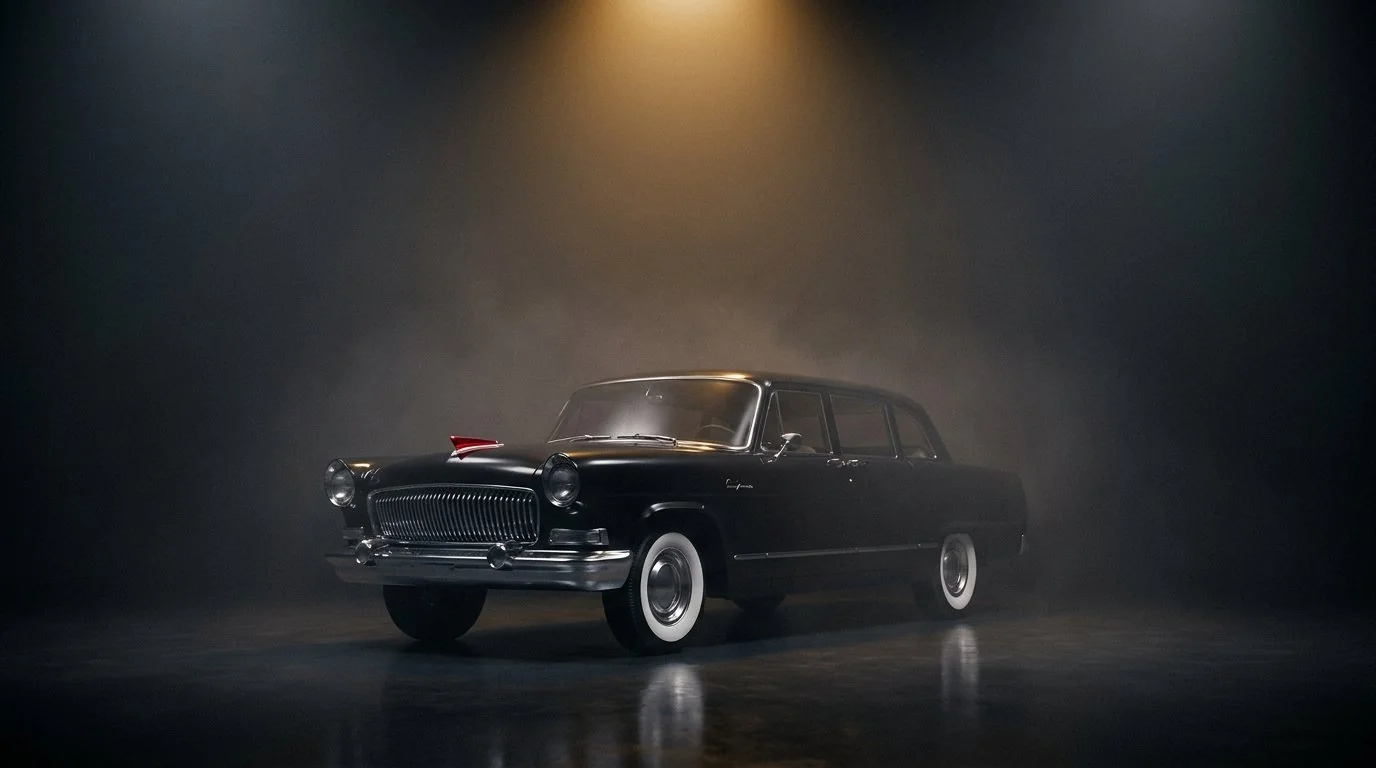
Changchun,
summer of '58.
Every Hongqi on the road today traces its lineage to a single hand-built prototype completed on the fifth of August 1958 — in a factory on the Manchurian plains, by engineers working largely by sight.
A car for the occasion of a nation.
In 1958, the First Automobile Works — FAW — in the city of Changchun was given a brief that had nothing to do with the domestic market. The People's Republic of China, nine years old, had no ceremonial vehicle of its own. State functions, official visits, and parades relied on imported Soviet ZIS limousines and occasional American cars inherited from the Nationalist era.
The directive was simple: build a car worthy of carrying the Premier of China. Build it entirely in China. Build it by October.
The result was the CA72 — a large, imposing, formally styled sedan with a vertical chrome grille, suicide doors, and a red flag hood ornament. It was built by hand, in small numbers, and reserved from the outset for state use. The name Hongqi, 红旗, was chosen for the obvious reason: the flag represents the nation.
The grille, from the first day.
The vertical chrome grille — meant to evoke the fluttering of a flag — appeared on the CA72 from its first prototype and has remained the marque's defining feature across every successor model. Unlike European luxury brands, which have refined a horizontal grille tradition across a century, Hongqi began with a vertical signature and has never deviated.
In 1965, the CA72 was succeeded by the CA770 — a longer, six-window limousine that would serve as the principal Chinese state car for the next quarter century. It is the CA770 that appears in archival footage carrying Mao Zedong, Zhou Enlai, and visiting foreign dignitaries through Tiananmen Square.
Production at ceremonial scale.
Hongqi did not produce cars in conventional volumes. Across the CA72 and CA770 generations — spanning nearly three decades — total production ran to a few thousand units. Each car was hand-assembled, specified for a particular use, and generally delivered directly to state institutions rather than sold at retail.
This is the era that established what Hongqi is: not a manufacturer that also makes ceremonial vehicles, but a ceremonial marque that occasionally produces mass-market variants. The priority was always the car that would carry the Premier. Everything else descended from that premise.
In 1981, Hongqi production was temporarily halted on the orders of then-Premier Deng Xiaoping, who considered the cars an unnecessary extravagance. The marque would not return in earnest until the late 1990s — and would not be meaningfully offered to private buyers until the 2010s.
The car was never built to sell.
It was built to represent.